
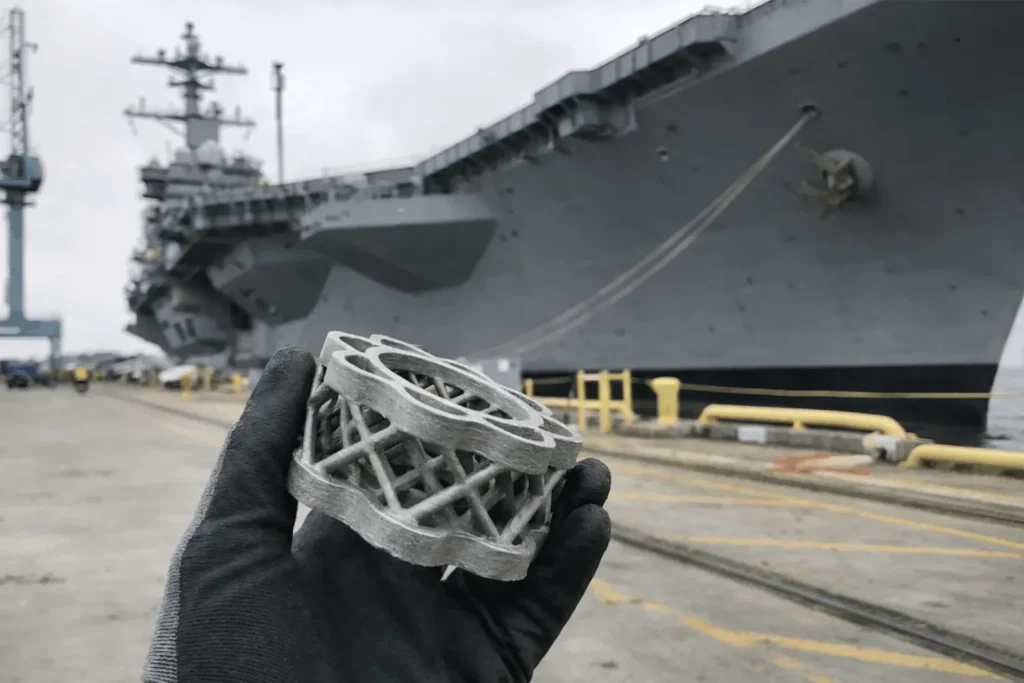
I’ve been watching the Navy’s 3D printing experiments with the kind of attention you reserve for things that might actually matter.
They just installed a 5-foot-long, 992-pound metal valve manifold on a nuclear aircraft carrier. 3D printed. Not prototyped. Not tested in a lab somewhere. Actually installed on an operational warship.
The submarine guys printed parts in under five weeks that would have taken 17 months through conventional manufacturing.
And here’s what nobody’s saying out loud: this isn’t about 3D printing anymore.
The Problem Everyone Knows But Nobody Fixes
The aerospace supply chain has a casting and forging problem that’s been bleeding the industry for years.
Lead times for titanium run nine months. High-demand steel alloys from single suppliers stretch to 70-80 weeks. Aircraft worth hundreds of millions sit grounded because one component hasn’t arrived.
The submarine industrial base shrank 70% since the 1980s. From 17,000 suppliers to 5,000. The companies that do castings, forgings, and fittings represent the most fragile parts of the entire defense manufacturing ecosystem.
Vice Adm. Robert Gaucher put it plainly: these are the bottlenecks we need to fix.
Matt Sermon, executive director of PEO-Strategic Submarine, called metallic additive manufacturing “our Manhattan Project.”
That’s not hyperbole. That’s someone who sees what’s coming.
Why Pure 3D Printing Won’t Save Defense Manufacturing
The Navy accelerated additive manufacturing from promising capability to warfighting capability in 2025, slashing lead times by 70%.
Forward Deployed Regional Maintenance Center Rota reduced repair times by 80% using AM to fabricate required parts.
These numbers look great in PowerPoint.
But here’s what the data actually shows: pure additive manufacturing hits a wall when you need the material properties of traditional casting.
A naval materials expert noted that while a printed part can meet or exceed properties of a cast product, it remains impractical to match properties equivalent to a wrought product that’s been forged or treated.
A senior Boeing additive manufacturing leader said it plainly: additive works great for complex parts that are hard to machine, but for simple parts like brackets or castings, it will be more expensive and have negative trades compared to traditional methods.
You can’t 3D print your way out of a casting crisis if the printed parts don’t perform like castings.
The Hybrid Approach Nobody Talks About
Investment casting combined with additive manufacturing and vertically integrated processes is emerging as the solution to aerospace and defense backlogs.
The Navy plans to use additive manufacturing to fabricate parts previously made using casting, reducing lead times and optimizing the supply chain for nuclear submarine components.
This isn’t either/or. This is both.
The breakthrough comes from using ceramic 3D printing to eliminate the tooling bottleneck in investment casting while preserving the material properties defense applications actually require.
Traditional investment casting requires 12 process steps. Seven of those steps exist purely to create and manage tooling. Wax patterns. Injection molds. Dies. Months of lead time before you even start making parts.
Ceramic 3D printing eliminates those seven steps entirely.
You go from CAD file to ready-to-pour ceramic shell. No tooling. No wax patterns. No waiting for dies to be machined.
Then you pour metal using the exact same investment casting process that’s been qualified for decades. Same metallurgy. Same material properties. Same ASTM standards.
The part that comes out meets every specification a traditionally cast part would meet. Because it is a traditionally cast part. You just removed the months of tooling development.
What the Budget Numbers Actually Mean
DoD spending on additive manufacturing jumped from $300 million in 2023 to approximately $800 million in 2024. That’s 166% growth year over year.
The FY 2026 budget request allocates $3.3 billion for AM-related projects. An 83% increase from the previous year.
Those aren’t research budgets. Those are production budgets.
The global additive manufacturing market in aerospace and defense was valued at $2.76 billion in 2022. Expected to reach $17.9 billion by 2032. Growing at 20.48% CAGR.
But here’s what matters: the money is flowing toward hybrid solutions that combine AM with traditional manufacturing processes.
3D Systems’ participation in the Penn State-led IMPACT 3.0 program advances additive integration into casting and forging workflows. MetalTek’s AMC project focused on modernizing casting operations by implementing automated processes, advanced data collection, additive manufacturing processes, and process simulation techniques.
The pattern is clear. The defense industrial base isn’t choosing between additive and traditional manufacturing. It’s building systems that use both.
The 2030 Prediction Everyone’s Missing
By 2030, hybrid casting and 3D printing will dominate aerospace parts production.
Not because it’s innovative. Because it’s the only approach that solves both problems at once.
You get the speed and tooling elimination of additive manufacturing. You get the material properties and qualification standards of investment casting.
The Navy proved this works at scale. A 5-foot metal valve manifold on a nuclear carrier. Virginia Class submarine components fabricated in five weeks instead of 17 months.
The technology exists. The qualification pathways exist. The budget exists.
What’s missing is the infrastructure.
The DoD needs companies that can deliver precision metal castings without tooling investment. That can go from CAD to cast metal in days instead of months. That can handle everything from aluminum to single-crystal superalloys.
The Navy called this their Manhattan Project for a reason.
They’re not looking for incremental improvements. They’re looking for companies that can fundamentally change how defense manufacturing works.
What This Means for Defense Contractors
If you’re waiting for perfect technology before adopting hybrid manufacturing, you’re already behind.
The Navy operations data shows 70% lead time reductions and 80% faster repairs. Those numbers compound across programs.
Supply chain challenges have sent costs spiraling by at least $11 billion this year according to IATA. Lead times for critical alloys stretch beyond a year. The industrial base continues shrinking.
The companies that figure out hybrid casting and AM integration will own the next decade of defense manufacturing.
The companies that don’t will keep explaining why their parts are late.
The Navy already made their choice. They’re installing 3D-printed metal components on nuclear carriers and submarines. They’re planning Digital Foundry installations at Tinker and Robins Air Force Bases. They’re allocating billions in budget.
The question isn’t whether hybrid manufacturing becomes standard. The question is whether you’ll be ready when it does.
Because by 2030, the defense contractors who can deliver precision castings in days instead of months won’t be innovative.
They’ll just be the ones still in business.