
DirectPour™ Process |
3D Printing Shells
Our DirectPour™ process eliminates all the tooling, wax patterns, and multi-step shell-building that have constrained traditional investment casting foundries for decades. Using our patented LAMP™ (Large Area Maskless Photopolymerization) technology, we 3D print ceramic shells directly from your CAD files — ready to pour in days, not months. Our end-to-end casting service delivers precision metal parts with zero tooling investment and a 50% cost reduction versus conventional investment casting.
Benefits of 3D Printing Shells
Zero Tooling Investment Required
Traditional investment casting demands $50,000–$200,000 or more in upfront tooling before a single part is made. DirectPour™ eliminates that barrier — submit a CAD file, and we engineer your shells immediately, with no capital risk and no minimum order quantities.
Eliminating tooling removes the single largest cost and schedule driver in conventional investment casting.
Accelerated Production Timelines
Conventional investment casting lead times run multiple weeks to months when tooling design, manufacture, and qualification are factored in — our process delivers first parts in as little as 10 days. Seven of 12 traditional process steps are eliminated and replaced by a single LAMP™ printing step.
Your major components reach the pour stage faster than a traditional foundry can finish its tooling quote.
Complex Geometries Made Simple
Our additive manufacturing approach enables design freedoms that traditional tooling cannot match, producing monolithic shells with features not possible with traditional wax-based processes. An aviation oil pump previously requiring 12 separate tooling sets was reduced to a single printed ceramic shell.
Geometries that once required months of tooling development can now be produced as finished castings in days.
Signs You Need Advanced 3D Printing Shell Solutions
If your casting program is running into walls, the DirectPour™ process may be the solution your engineering team needs. Common indicators include:
If any of these describe your current situation, our digital casting workflow can get your program back on track quickly and cost-effectively.
What Is Our DirectPour™ Process?
CAD-to-Casting Workflow
The DirectPour™ process begins the moment you submit a CAD model — no tooling required, no minimum order, no delay. Our engineering team evaluates your design for casting feasibility and builds the complete shell model, replacing the entire tooling design phase with a single digital step.
- STEP, IGES, and native CAD formats accepted.
- Wall thicknesses, draft angles, internal passages, and gating strategy reviewed upfront.
- Casting simulations to validate metal flow and solidification paths.
- Integrated cores and gating systems designed into the shell model.
- 3D scans and 2D engineering drawings accepted when no CAD file exists.
Every workflow decision is made before printing begins, driving higher first-pour success rates across all program types.
Material Capabilities
Our DirectPour™ shells are compatible with hundreds of standard alloys across both air-melt and vacuum-melt foundry processes — all meeting ASTM standards and Investment Casting Institute-stated ranges. From common structural steels to exotic single-crystal superalloys, our system supports the full spectrum of precision casting material requirements.
- Air-melt alloys: stainless steels (304, 316, 17-4 PH, 15-5 PH, CF3M), tool steels (S7, 4140), aluminum (A356, A357, A380), nickel alloys (Inconel 625).
- Vacuum-melt superalloys: equiaxed (IN 718, IN 713LC, MAR-M247, IN100), directionally solidified (René 141, René 80, René 142), single crystal (CMSX-4, René N5).
- Medical-grade Cobalt Chromium Moly (ASTM F75 equivalent) for orthopedic and implant applications.
- All alloys poured to ASTM standards with full chemistry and metallurgical traceability.
No matter your application — aerospace, defense, industrial gas turbine, or medical — our material capabilities scale with your program requirements.
Quality Standards
Third-party laboratory qualification confirms our castings meet or exceed traditionally produced investment castings — verified across chemistry, metallurgy, dimensional accuracy, and surface finish. Our ceramic shell system is engineered for consistent, repeatable results that satisfy the most demanding aerospace and defense specifications.
- Surface finish below 4 microns RMS and density above 99.5% — validated by independent lab testing.
- Shell material: fused silica with zirconium silicate; shell thickness controlled to ±10 micron layer accuracy, fired to 2,800 psi modulus of rupture.
- NDT available per specification: radiography, FPI, and dimensional inspection.
- Full ASTM qualification with negligible mold-material interaction confirmed.
Every casting ships with the documentation and traceability your program requires.
Video Showcase
Our DirectPour™ Shell Production Process
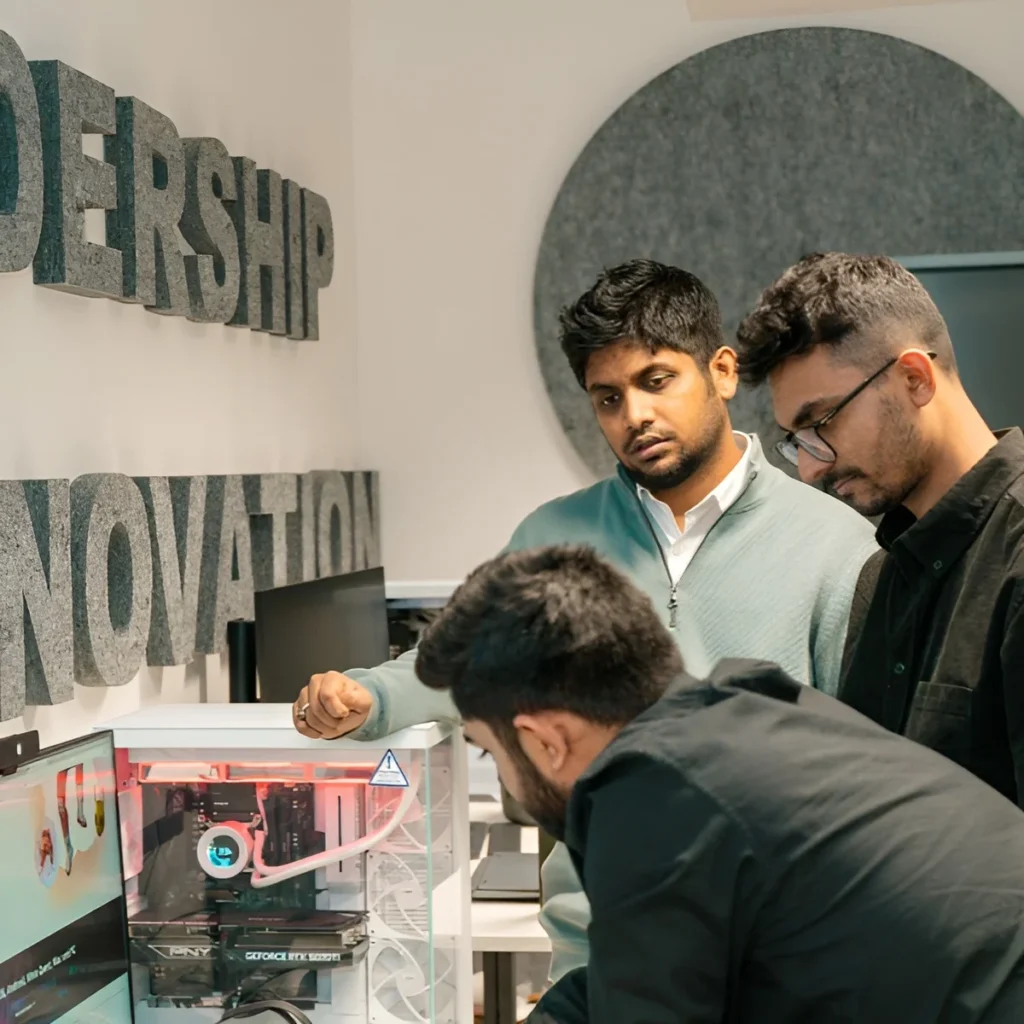
Digital Design and Engineering Review
Our engineering team reviews your CAD model for casting feasibility and builds a complete ceramic shell model — integrating cores, gating, risering, and pour cup geometry as a single optimized design. This digital-first review replaces the traditional tooling design phase.
Every engineering decision is resolved before printing begins, driving first-pour success rates that consistently outperform traditional casting workflows.
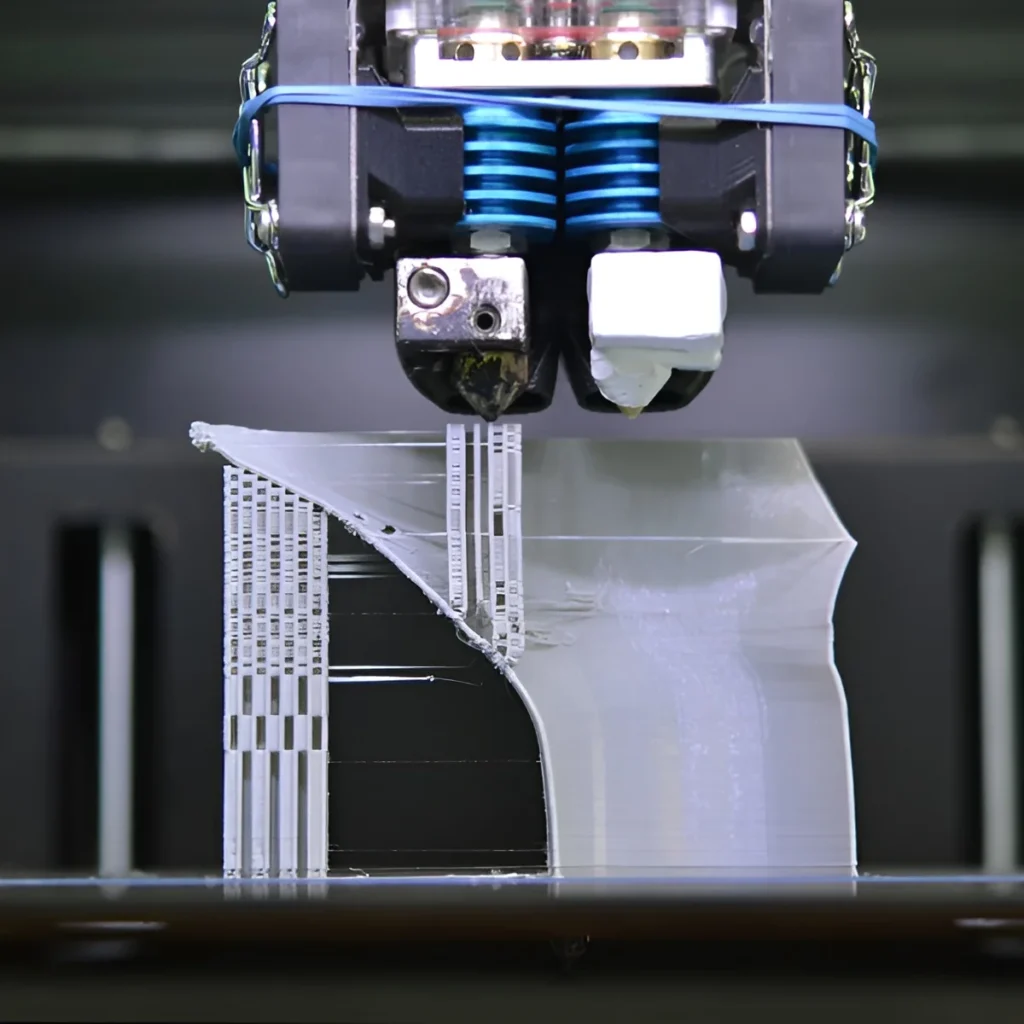
LAMP™ 3D Printing Production
The approved shell design is loaded into our LAMP™ production system, where ceramic shells are built layer by layer with precision accuracy — no tooling, no manual intervention. Multiple shells print simultaneously within a single build cycle.
The result is a fully formed ceramic shell ready for thermal processing — straight from a digital file.
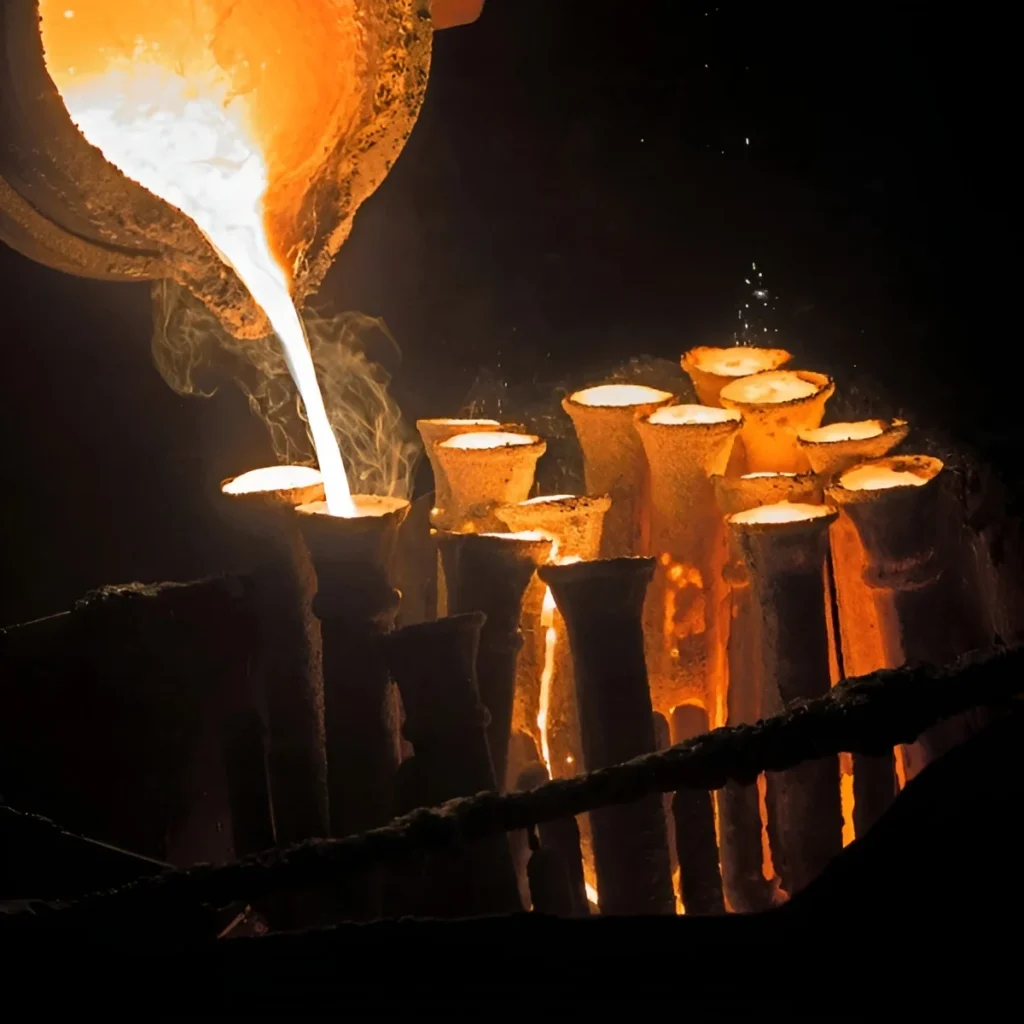
Thermal Processing and Delivery
The printed green shell moves directly into thermal processing — binder burnout followed by high-temperature firing — producing a ready-to-pour ceramic mold with no manual intervention between steps.
From digital file to fired ceramic shell, every step is controlled, documented, and repeatable.
3D Printing Shells Cost Structure
Our process delivers a fundamentally different cost model compared to traditional investment casting. The primary drivers of the 50%+ cost reduction include:
Zero upfront tooling costs — no dies, no wax injection tooling, no core tooling to design or manufacture
Elimination of wax pattern expenses — no wax material, injection equipment, or pattern storage required.
Elimination of wax melt-out and shell burnout steps.
Reduced labor and processing steps — from 12 traditional steps down to 5 with DirectPour™.
Energy savings up to 90% — validated through an ARPA-E program conducted with GE Vernova.
Lower scrap rates and defect reduction — 90% fewer scrap sources by eliminating cumulative defect opportunities.
The result is a casting cost structure that works for prototypes, legacy part replacement, and series production alike.
Why Choose Rapid Precision Castings for 3D Printing Shells?
Proven Technology Leadership
Our LAMP™ technology was born from a 2006 DARPA call for Disruptive Manufacturing Technologies and developed at Georgia Tech by founder Dr. Suman Das. Over $25 million in government and private funding and 26+ patents validate our technical leadership.
Our intellectual property foundation and government-validated performance set us apart from any competing casting technology on the market.
Strategic Industry Partnerships
Our partnerships span North America’s leading casting networks, energy OEMs, and defense programs — validating DirectPour™ at the highest levels of industrial and aerospace manufacturing. Each relationship reflects active, production-level collaboration.
These partnerships demonstrate proven readiness across defense, aerospace, and industrial gas turbine applications.
Comprehensive Service Portfolio
Our end-to-end capabilities cover every stage of the casting process — from CAD review through finished metal parts — supported by an established foundry partner network and full government contracting credentials. We serve prototypes and production programs under the same integrated workflow.
Whether you need a single prototype or a sustained production program, our service portfolio scales to meet your requirements.
Service Areas Across the United States
Operating from our Atlanta, Georgia, headquarters, we serve customers nationwide with CAD-to-casting services that require no geographic proximity — finished castings or ready-to-pour shells ship directly to your facility or partner foundry. Key service areas include:
Atlanta, GA (Headquarters — 1876 Defoor Ave NW, Suite 3
Space Coast, FL — aerospace and defense manufacturing hub
Huntsville, AL — NASA and defense aerospace corridor
Dallas/Fort Worth, TX — aerospace and defense manufacturing hub
Los Angeles/Southern California — space and aviation industry cluster
Seattle, WA — commercial aerospace supply chain
Hartford/New England, CT — precision aerospace casting corridor
Oklahoma City, OK — Tinker Air Force Base and defense sustainment
Warner Robins, GA — Robins Air Force Base sustainment operations
Warner Robins, GA — Robins Air Force Base sustainment operations
Washington, D.C. / Northern Virginia — defense program management
Houston, TX — energy, oil & gas, and industrial applications
Detroit, MI — automotive and industrial casting programs
Chicago/Midwest, IL — industrial machinery and fluid handling
Get Started with Your 3D Printing Shells Project
Starting a DirectPour™ project is straightforward — submit your CAD file, and we’ll handle the rest, from shell engineering through finished castings. Reach us through any of the following:
Whether you’re evaluating a pilot project or ready to move a production program to digital casting, we’re ready to help you get to metal faster.
Frequently Asked Questions
In investment casting, a shell is the ceramic mold structure that forms the casting cavity — the negative space defining the shape of the final metal part. Our DirectPour™ process replaces the traditional multi-step shell-building sequence with a single LAMP™ printing step, producing a monolithic ceramic shell with integrated cores and gating — ready to pour.
The number of shells per print depends on part size, complexity, and build platform optimization. Our LAMP™ production system features a 600 × 600 × 600mm build volume, allowing multiple shells to be nested and printed simultaneously — cutting print time per part by spreading build cycle costs across the full platform.
Rapid Precision Castings serves customers across the entire United States from our Atlanta, Georgia, headquarters — no local presence required. Submit your digital files, and we ship finished castings or ready-to-pour shells directly to your facility or foundry partner. Contact us to confirm lead times and shipping for your location.