
I’ve spent years watching defense contractors announce record backlogs and production ramps. The headlines focus on fighter jets and missile interceptors. The stock analysts dissect earnings guidance and geopolitical tailwinds.
But I keep coming back to a manufacturing process most people have never heard of.
Investment casting, the ancient lost-wax technique that creates the complex metal components inside everything from F-35 turbine blades to Patriot missile housings, is quietly determining which defense contractors can actually deliver on their promises.
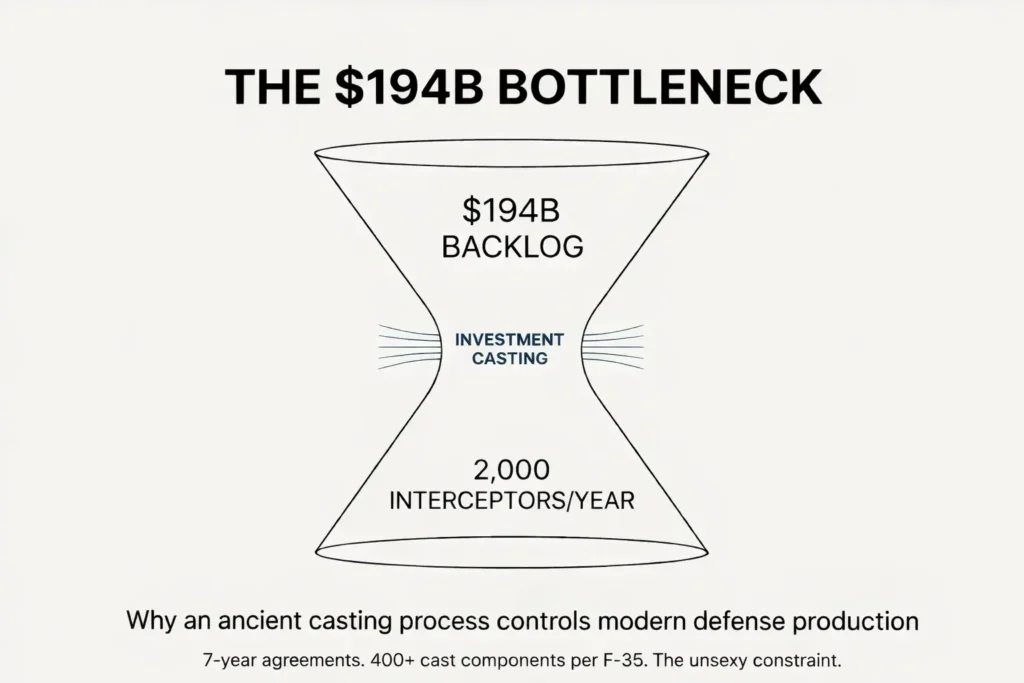
And right now, with Lockheed Martin’s $194 billion backlog representing 2.5 times annual sales, the companies that control this capability control the defense innovation pipeline.
The Production Bottleneck Nobody Talks About
Lockheed just reported plans to ramp Patriot PAC-3 interceptor production from 600 to 2,000 units annually. They secured agreements to quadruple THAAD interceptor output from 96 to 400 units per year.
Those numbers sound impressive in a press release.
But here’s what I know from tracking defense manufacturing: you can’t triple missile production without tripling your investment casting capacity. And investment casting facilities take years to build, certify, and scale.
Each missile interceptor contains dozens of precision-cast components. Turbine blades. Structural housings. Guidance system mounts. These parts can’t be machined from solid blocks because the geometries are too complex, the weight requirements too stringent, the material properties too specific.
Investment casting creates near-net-shape components with intricate internal passages, thin walls, and complex geometries that traditional manufacturing simply can’t achieve. The process allows engineers to design parts that optimize performance rather than manufacturability.
That’s why it matters.
Why F-35 Production Runs Five Times Faster Than Competitors
Lockheed delivered 191 F-35 fighters in 2025, a record that puts annual production at five times the pace of any other allied fighter currently in production.
That dominance didn’t come from better marketing or Pentagon relationships.
It came from vertical integration of investment casting capabilities that competitors lack.
A single F-35 contains over 400 investment-cast components. The engine alone uses more than 1,400 directionally solidified and single-crystal turbine blades, each one requiring precise temperature control during casting to achieve the crystalline structure that enables operation at temperatures exceeding 2,000°F.
When you’re producing 191 aircraft annually, you need roughly 268,000 precision turbine blades. Per year.
You can’t outsource that to a third-party foundry and maintain production schedules. You need owned capacity, dedicated quality systems, and proprietary process controls that take decades to develop.
Lockheed invested over $3.5 billion during 2025 specifically in expanding production capacity and advancing next-generation technologies. A significant portion of that capital went into casting facilities that most analysts never mention in earnings calls.
The Ceramic Shell Problem
Here’s a detail that reveals how specialized this gets: investment casting relies on ceramic shell molds built up in dozens of layers around wax patterns.
Each layer requires specific drying times. The shell chemistry must match the alloy being cast. The mold must withstand molten metal at temperatures up to 3,000°F while maintaining dimensional accuracy measured in thousandths of an inch.
Scaling production means scaling ceramic shell production, which means dedicated facilities, specialized materials supply chains, and quality control systems that can detect microscopic defects before they become $150 million aircraft failures.
The companies that solved this problem ten years ago are the ones announcing production ramps today.
Combat Performance Creates the Demand Loop
I’ve noticed something interesting in the data: real-world combat effectiveness accelerates production commitments faster than any sales pitch.
The F-35’s operational success, including roles in Operation Midnight Hammer against Iranian air defenses and active deployment by Polish forces to intercept hostile drones, drove Italy to add 25 aircraft and Denmark to add 16 jets to their programs.
Battlefield performance validates design decisions made years earlier. And many of those decisions involved investment casting trade-offs.
Engineers choose cast titanium over machined aluminum because the casting process enables complex internal structures that reduce weight while maintaining strength. They specify single-crystal turbine blades because the casting process can eliminate grain boundaries that cause high-temperature failure.
These aren’t abstract engineering preferences. They’re the difference between an aircraft that performs as specified under combat conditions and one that doesn’t.
When defense ministries see actual combat results, they commit to multi-year production contracts. Those contracts drive the $194 billion backlogs that require expanded casting capacity to fulfill.
The Seven-Year Framework Agreements Signal a Shift
Lockheed secured a seven-year framework agreement for Patriot PAC-3 missiles and separate long-term commitments for THAAD interceptors.
Seven years is significant.
That’s enough time to build new casting facilities. To certify new alloys. To train specialized workforce. To establish redundant supply chains for ceramic shell materials and specialty waxes.
Traditional defense contracts operate on annual appropriations cycles. You get funding for this year’s production, maybe next year’s if you’re lucky. Long-term planning becomes impossible.
Framework agreements change the investment calculus. They justify the capital expenditure for dedicated casting capacity because you have visibility into seven years of demand.
This represents a fundamental shift in defense acquisition strategy—and it directly enables the manufacturing innovations that improve production efficiency.
When you know you’ll be casting 2,000 interceptor housings annually for seven years, you can invest in automated shell building systems. You can develop proprietary alloys optimized for your specific casting parameters. You can build redundancy into your furnace capacity.
Without long-term commitments, you’re stuck with flexible but inefficient general-purpose foundry equipment.
The $80 Billion Revenue Forecast Requires Manufacturing Reality
Lockheed projects fiscal 2026 revenue between $77.5 and $80.0 billion, roughly 5% growth at midpoint. Management expects segment operating profit to grow more than 25% year-over-year.
That profit margin expansion tells me something important: production efficiency is improving faster than revenue growth.
You don’t get 25% profit growth on 5% revenue growth through better PowerPoint presentations. You get it through manufacturing improvements that reduce unit costs while maintaining quality.
Investment casting offers specific opportunities for efficiency gains:
Yield improvement: Reducing scrap rates from 8% to 5% on high-value titanium castings drops material costs significantly across thousands of components.
Cycle time reduction: Optimizing ceramic shell drying schedules and furnace loading patterns increases throughput without adding capacity.
Design optimization: Consolidating multiple machined parts into single cast components reduces assembly labor and eliminates potential failure points.
These improvements accumulate across hundreds of part numbers and thousands of production units. They’re invisible in quarterly earnings calls but visible in operating margin expansion.
The Geopolitical Demand Driver
Russia’s ongoing conflict in Ukraine. Middle East tensions. China’s military modernization. These aren’t abstract geopolitical trends. They’re purchase orders for precision-cast missile components.
Allied nations watching these conflicts reach the same conclusion: air and missile defense capabilities need expansion. The F-35 fleet surpassed 1,300 aircraft across 12 nations because operational requirements changed.
That demand feeds directly into casting capacity requirements.
Each new F-35 customer needs spare parts inventory. Each missile defense expansion requires interceptor stockpiles. Each stockpile requires thousands of cast components.
The companies with established casting capabilities capture this demand. The ones still building foundries watch from the sidelines.
What This Means for Defense Innovation
I keep seeing articles about artificial intelligence in defense systems. Autonomous drones. Hypersonic weapons. Next-generation sensors.
All important developments.
But here’s what I know: you can’t field any of those innovations without the manufacturing capability to produce them at scale.
Investment casting isn’t glamorous. It doesn’t generate TED talks or venture capital interest. It’s a 5,000-year-old process that happens in hot, dirty foundries far from corporate headquarters.
Yet it determines which defense contractors can actually deliver on their innovation promises.
The next breakthrough fighter design means nothing if you can’t cast the turbine blades that make the engine work. The most sophisticated missile guidance system fails if the cast structural housing cracks under thermal stress.
Lockheed’s $3.5 billion investment in production capacity wasn’t primarily about assembly lines or software systems. It was about the unglamorous manufacturing processes that enable everything else.
The companies that understand this—that treat casting capability as strategic advantage rather than commodity manufacturing—are the ones announcing record backlogs and seven-year framework agreements.
The Unsexy Truth About Defense Dominance
Wall Street analysts will focus on Lockheed’s 2026 EPS guidance of $29.35 to $30.25. They’ll discuss geopolitical tailwinds and Pentagon budget projections.
I’m looking at something different.
I’m looking at the manufacturing capabilities that turn $194 billion in backlog into actual delivered hardware. The foundries that can scale from 600 to 2,000 interceptors annually. The process engineering that enables 191 F-35 deliveries when competitors struggle to reach 40.
Investment casting is the unsung hero of defense innovation because it’s the constraint that determines everything else.
You can design revolutionary weapons systems. You can secure massive production contracts. You can project impressive revenue growth.
But if you can’t cast the components at scale, with consistent quality, at competitive costs, then none of that matters.
The defense contractors winning today are the ones who figured this out years ago. They invested in casting capacity when it wasn’t fashionable. They developed proprietary processes when analysts questioned the capital allocation. They built redundant supply chains when efficiency experts recommended outsourcing.
Now they’re announcing record backlogs while competitors explain production delays.
That’s not luck. That’s understanding which capabilities actually matter when you need to deliver 2,000 missile interceptors annually for seven years straight.
The metal matters. The process matters. The unglamorous manufacturing capability that nobody talks about is what determines defense dominance in an era of sustained geopolitical demand.
And right now, the companies that control investment casting capacity control the future of defense production.